
The Political Middle Is a Practice, Not a Position
Paul Dumouchel joins us to explore trust, accountability, and a political middle defined by how we treat one another.

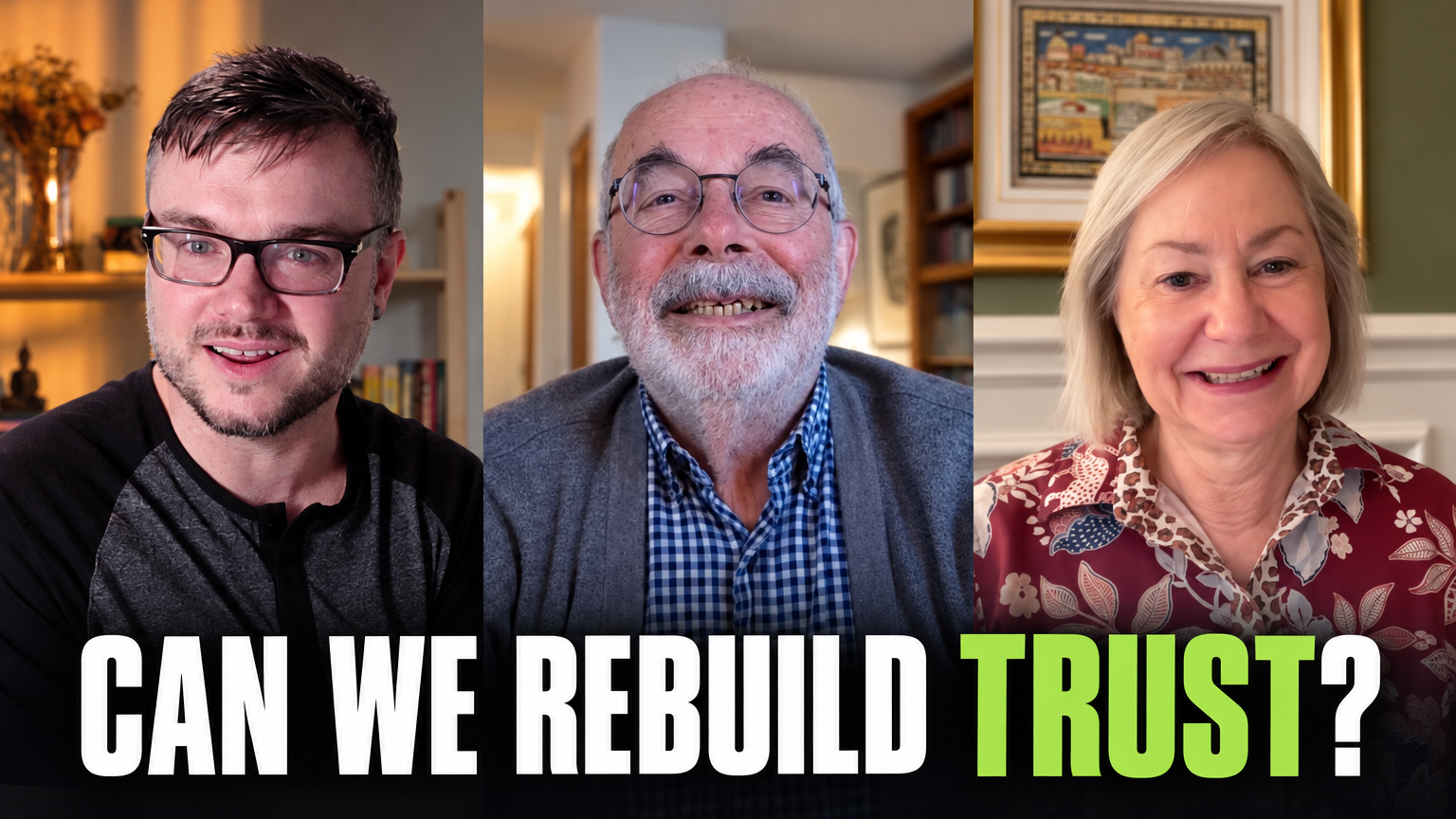
Today marks the launch of our second season of Third Things First, our peacebuilding video podcast!
This podcast centers conversations about living nonviolently in a violent world, nurturing hope that a more peaceful future is not only possible but within reach.
In our second season, we explore the risks and rewards that come when we stop depending on violence to bring us peace. The Myth of Good Violence provides us with certainty that good can conquer evil. Without that certainty, we may experience fear or anxiety, a sense of spiritual vertigo, like falling into an abyss.
In truth it may be that peace is something we fall into if we can summon fearlessness in the face of uncertainty. With a new format this season, we will focus on practicing uncertainty together to better prepare ourselves to leave behind the Myth of Good Violence. The new possibilities for peace that emerge may surprise us! So welcome to our first episode of “Falling into Peace.”
With that in mind...
Do you remember the last time you bonded with someone over the hatred you shared for someone else?
It's an uncomfortable question, but the fact is that any one of us can probably answer it fairly quickly. The US midterm elections were just last week, after all! And while many of us are celebrating the results – either jubilantly, or with a little more caution – it's hard to deny that much of the energy over the past several months has come from feeling that we were arrayed against a common enemy.
A shared enemy can feel remarkably like a shared purpose. We know who is wrong, we know where we stand; for a moment, the world becomes simpler.
But agreement about who to blame is not reconciliation. It does not make the world less polarized.
In most conversations, "depolarizing" usually implies a move towards an undefined political "center," and with it a certain willingness to let go of things we care deeply about. We often imagine that finding common ground means softening our convictions until we can meet somewhere in the middle. As a result, that middle often feels empty, at best. At worst, it's oblivious to real harm.
But what if rebuilding trust – in our neighbors and in our institutions – does not require anything of the kind?
In our latest episode of Third Things First, philosopher Paul Dumouchel offers another possibility: Perhaps the middle we need is less a set of opinions, and more a way of behaving. The willingness to disagree strongly with someone and still recognize actions that are honorable or done in good faith action. Taking someone’s words seriously without pretending those words are harmless. Being consistent in our accountability, to show just how seriously we take the words of others and how much we value we place on our own trust.
From such commitments, a useful question emerges that strikes at the root cause of polarization: Are we still paying attention to the problem, or have we become absorbed in the person we oppose?
On this point, Paul draws on René Girard's mimetic theory to describe how conflict can pull our attention away from the world we share. In a truly polarized society, who said what matters more than whether something is true, useful, or worth considering. Winning against our rivals doesn't automatically change this attitude; if our celebrations don't also turn our attention back towards the truth, then we're still displacing the work of addressing the real problems.
The musical Wicked gives us a vivid image of what can disappear in that struggle: the voices of the Animals, or whoever the vulnerable and marginalized are in our own communities. Who do we stop hearing when our own side’s goodness becomes the thing we must protect at all costs?
Our full conversation explores institutional trust, shared activities, and why rebuilding a common life cannot be reduced to a universal formula. It also connects with the hope behind The Wicked Truth’s community study conversations: shifting our attention from people towards the problems we might address together.
There is room here for conviction, uncertainty, and accountability. The difficult work is learning how to hold them together.
Watch the conversation, then join us in discussing its central question: Can we rebuild trust without giving up our convictions:
📺 WATCH NOW on YOUTUBE
🎧 LISTEN on APPLE PODCASTS and SPOTIFY
https://www.youtube.com/watch?v=fa2ZX5D1VxE
Please remember to LIKE, COMMENT and SUBSCRIBE if you watch us on YouTube, and to RATE and REVIEW the podcast if you listen on Apple or Spotify! Then, share this episode with a friend or on social media! It's the best way to help us grow and expand our community.