Chasing Totality
The story of how a not-quite-total eclipse and a prize-winning scientist taught me that wonder and meaning always outstrip our need to unlock all the universe's mysteries.

Thank you for following me in 2025, for reading my posts, and for encouraging me with your comments and messages! I hope you will continue to find fun, engaging and meaningful content here at The Wicked Truth!
In the new year, our Wicked journey will deepen as our imaginations open us to the wonder, beauty and peace available to us this side of the rainbow. I’ll share more of what I have planned soon, but for now, please enjoy this post about the wonder of the stars and how it feels to discover new things about yourself and your world.
Please remember to always mourn the wicked – It’s what good people do.
In 2017 my husband Keith and I camped out with 2 other couples in Wyoming to watch the solar eclipse. No one was as excited about the eclipse as I was, but they pulled together to make it happen for me. We camped on a ranch set in a gorgeous mountain glen. It’s ideal for cows, but lacking in all amenities, so the other couple contributed their camper and portable toilet. We stocked up on groceries and drove from Heber City, Utah the day before the big event, packed and ready with 6 pairs of eclipse glasses I had ordered.
I knew the ranch wasn’t precisely in the path of totality. It was off by about 20 miles, which mattered little to my eclipse companions. I don’t mean to say the experience wasn’t spectacular, but it wasn’t total. Sure, the sky darkened, but not so much that we could see stars. The temperature dropped some and the wind picked up, and the sun was nearly blocked.
But that sliver of sun left me disappointed. I felt I had missed out on a rare experience that people only 20 miles away were having.
When we got back to civilization, I looked up when the next solar eclipse would be in North America. I got lucky: In only 7 years, on April 8, 2024, another path of totality would cut across a vast swath of the US. So began my determined quest to make sure nothing would block my experience of total totality.
That’s why, in March 2023, I booked an eclipse tour led by an astronomer to view totality in Austin, Texas. What could go wrong this time? An astronomer was making sure we were in the right place for clear skies at the right time.
But a year later, the forecast for the week of April 8 in Austin was horizon-to-horizon cloud cover.
I tried not to worry that my clever planning would lead to another disappointment. The tour included two days of lectures by astronomers, cosmologists, astronauts, and NASA executives to round out our eclipse experience. I ate it up! These were people devoted to learning everything they could about the cosmos and our place in it. , I sat down for lunch, and my little table of 3 was soon joined by a man wearing a badge that said “Lecturer” below his name. I thought, here’s a bit of luck anyway – I’ll get to meet one of the scientists.
The man turned out to be Nicholas B. Suntzeff, who was on the team of scientists that discovered dark energy. Yes, dark energy – the discovery that won the Nobel prize for physics in 2011. Dr. Suntzeff explained that “dark energy” was the name his team gave to the mysterious force causing the expansion of the universe. Galaxies are moving further and further apart, and nothing in the known, observable universe can explain that. It was Dr. Suntzeff’s meticulous measurements and observations that proved the galaxies were indeed moving away from each other.
I’ve read about this stuff, and eagerly asked my question: “When you say ‘dark,’ do you mean it’s not detectable by the instruments we have now, or we just don’t quite know what kind of energy it is?”
“It’s worse than that,” he said. “We came up with the name dark energy to indicate that what we are observing about the expansion of the universe requires something to drive the expansion, but what that is is a mystery, and will probably remain a mystery.”
Remain a mystery, forever? A top scientist telling me this placed me in a state of existential vertigo — and then he added this zinger that toppled me:
“We already have evidence that disproves the Big Bang theory of the origins of the universe.”
Wait, what? “What proof?” I asked.
“Well, the temperature needed for the big bang just isn’t possible to achieve….”
I won't pretend I understood what he said. What my liberal arts brain could grasp was that physics seems to point to an “inflationary universe” that pre-existed the big bang.
“But doesn’t that just beg the question of the origin of the inflationary universe?” I asked. “Where did that come from?”
He shrugged. “We probably won’t find an answer to that one. Because of the expansion of the universe, we cannot observe things that have moved too far away from us. In the future, billions of years from now, the universe will have expanded so much that all an observer from Earth will be able to see is our own galaxy — no other stars, and no way of knowing that those stars ever existed.”
Now I was in a full-blown existential crisis. Until that moment, at a lunch table in a Hyatt hotel ballroom in Austin, Texas, I was unaware of just how much I had assumed all unknowables would eventually yield to the rigors of science — that science would advance enough that all the mysteries would be, dare I say it, totally revealed to us.
Of course, from there I teetered right over into a faith crisis. Contrary to popular opinion, faith and science are not opposites at all, but inextricably linked. What kind of God, I wondered, would create us with a quest to know the unknowable, and then plunk us down in a universe that was intrinsically unknowable?
My anxiety about whether the skies would clear in time for me to fulfill my quest for totality was now threaded through with the fear that my faith had finally met its match.
The next day, just before we wrapped up with (I kid you not) a magic show from a physicist, the last speaker said something like this: “Now that you know all the science behind eclipses, I want you to pause during totality tomorrow and take a deep breath. Look around at all the people who are with you for this unique astrological event, because this moment will never happen again – not this eclipse, and not the gathering of this group of people in this place. Marvel at the wonder of what is happening in the sky and in our midst. Enjoy totality, everyone!”
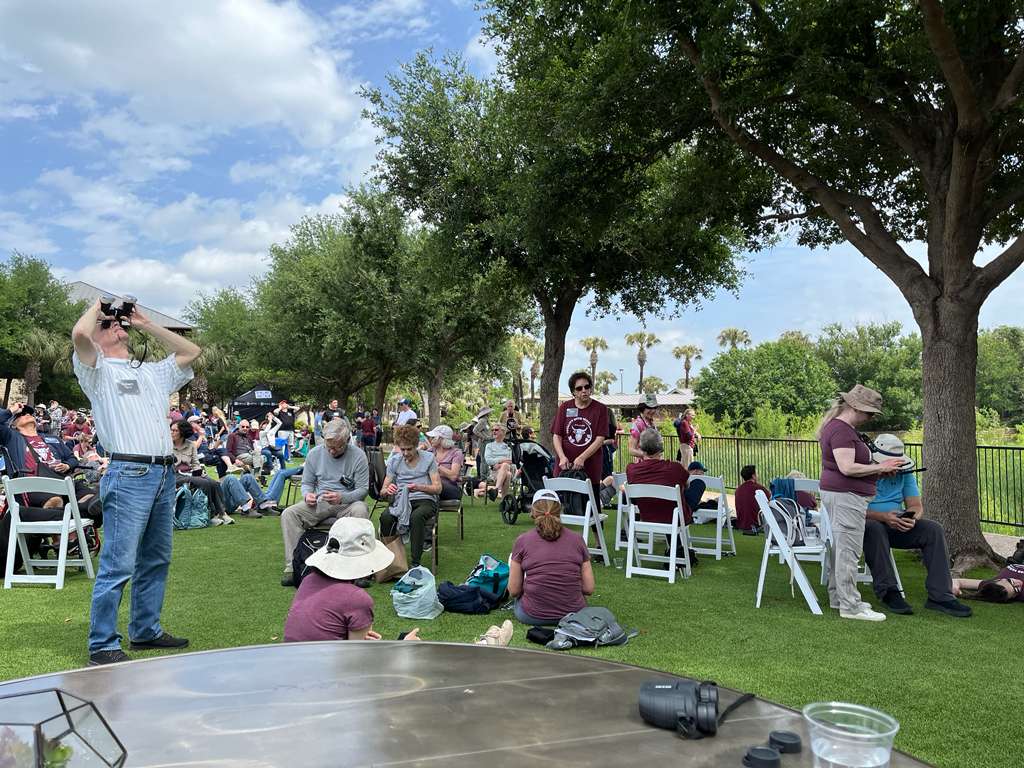
We enjoyed totality. Though the sky did not clear completely, we caught glimpses of the solar eclipse through breaks in the clouds, moving rapidly as though someone was opening and closing blinds. Each time the clouds moved away, we cheered in awe, wonder, and gratitude because we were given enough.
Was the universe letting me know that I don’t need to chase totality to have the experience of a lifetime? Maybe everything wonderful and worth knowing was happening each moment, every day — Not twenty miles away, or in Austin, or in a galaxy far, far away, but right in front of me, right now.
No special glasses needed.