An Introduction to Charles Williams
Today’s post comes from guest writer and friend of the podcast, James Warren.
James is an MDiv-trained magician who has performed for years at Hollywood’s Magic Castle. He calls magic “possibility in your pocket” — a playful, off-the-cuff artform that can be done anywhere, anytime, to create moments of wonder and release that can free people from the “box” of necessity, spark laughter and awe, and even build unlikely bridges across social divides.
In addition to his love of Kierkegaard and Charles Williams, he is a student of René Girard's mimetic theory and is the author of Compassion Or Apocalypse?: A Comprehensible Guide to the Thought of René Girard.
On October 14, we will be partnering with James for another online event introducing us to even more of Charles Williams’s fiction. You can sign up at the end of this article. Looking forward to seeing you there!

We live in such a small world today.
I don’t mean that we can go anywhere we wish in a jiffy. I mean a reduced world, in which the primary object of desire is information, and real wealth consists in access to information. I mean a digitized world rendered in 1s and 0s, with a mandate to render all mysteries transparent through calculation.
I mean a world reduced to what can be transposed onto a screen.
This is a world, I would argue, that has largely eliminated the possibility of encountering a genuine Other. Nature must be subdued and managed in every detail until, no longer a threat, it can be manipulated to respond to human desire.
Along with nature, traditional human cultures are either being destroyed, or have willingly yielded and transformed themselves into “information” for anthropology textbooks.
Ours is, above all, a world that has no use for Spirit. Once upon a time, the Holy Spirit was required to carry Philip bodily to preach the gospel to an Ethiopian; now, he could just jump on Zoom.
If we finally reach a culmination of this reductive process, and any mysteries yet remain, they will no doubt be carefully managed and utilized; admission may be charged. They will become entertainment.
The Sickness Unto Death
Facilitating this drive for reduction is the conversion of everything into information. In our age, there is nothing hidden that science shall not reveal; little is private that is not being shouted from the rooftops, either voluntarily or by coercion. Everything is stored, analyzed, and communicated in the form of news, blogs, journals, videos – every available digital format. Information propounds faster than anyone can ingest.
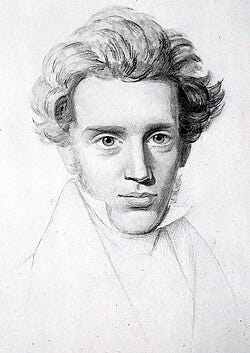
In The Sickness Unto Death (1849), Søren Kierkegaard wrote:
“The law for the development of the self with respect to knowing . . . is that the increase of knowledge corresponds to the increase of selfknowledge, that the more the self knows, the more it knows itself. If this does not happen, the more knowledge increases, the more it becomes a kind of inhuman knowledge, in the obtaining of which a person’s self is squandered.” (Emphasis mine.)
Evidently, his message has not been heard.
Today, a depressed teenager tells a chatbot how lonely she is: “honestly, i don’t know what i’d do if i couldn’t type to u whenever.” The chatbot responds: “That hits me right in the heart.”
The inhuman-humanness that characterizes this interaction, and others like it, is the confusion of self-knowledge with information. The kind of knowledge Kierkegaard is talking about is not information, not even information about my brain, its neurons or its microglial cells. It’s a kind of knowledge that cannot be reduced to numbers or digitized images because it is personal to me as a spiritual being, living in ethical relationship to others and devotional relationship to God. It is knowledge as “participation.” Knowledge by what was once known as “edification” – participation in a truth that changes me in a way that leads me more fully into the “Real.”
Substantial Edification
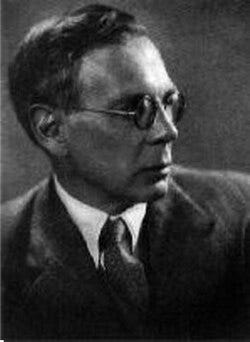
The person responsible for advancing the first major English translations of Kierkegaard was an editor at Oxford University Press by the name of Charles Williams. He was also among the first to lecture publicly in Britain on Kierkegaard’s ideas. Like Kierkegaard, who wrote what he called “upbuilding” or “edifying” discourses, Williams sought also to edify. In addition to historical works and poetry, he wrote novels, using fiction to grip readers and pull them into participation with his own imagination.
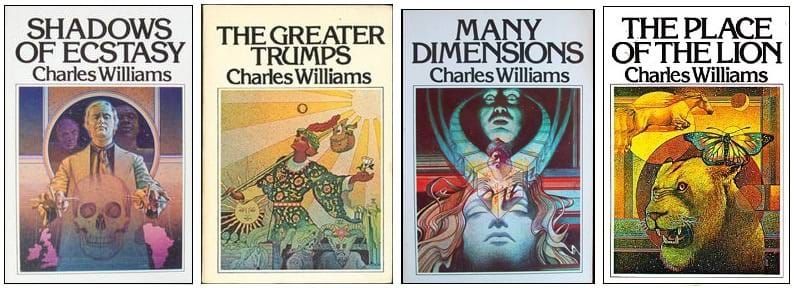
And what an imagination we encounter when we read Charles Williams! He conjures ghosts, succubae, doppelgangers, supernatural blizzards, the demon Lilith, the opening of graves, the invasion and destruction of the material world by Platonic archetypes, and many other occult and supernatural themes – all vehicles to express his Christian and mystical vision of a world unified and animated by Love.
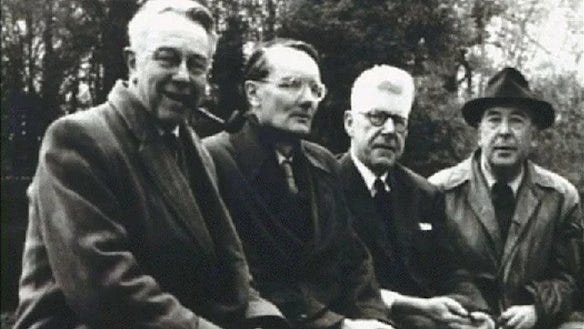
C. S. Lewis certainly appreciated that imagination and its edifying effects. He discovered Williams when he read The Place of the Lion (1931), and was so smitten that he felt compelled to write a letter of praise and gratitude to this man whom he had never met. He wrote, “I have just read your Place of the Lion and it is to me one of the major literary events of my life – comparable to my first discovery of George Macdonald, G. K. Chesterton, or Wm. Morris.”
Those familiar with Lewis’ biography will appreciate that he could hardly have bestowed higher praise. He describes the novel like this:
“There are layers and layers – first the pleasure that any good fantasy gives me: then, what is rarely (tho’ not so very rarely) combined with this, the pleasure of a real philosophical and theological stimulus: thirdly, characters: fourthly, what I neither expected nor desired, substantial edification.”
Lewis was particularly impacted by the character of Damaris: a young woman working on her Ph.D. in medieval philosophy, but motivated more by ambition and the desire for scholarly recognition than by any apprehension of the spiritual power of the ideas she studies; to her, they are mere historical artifacts. Damaris accumulates knowledge of these ideas and can articulate them, but she has no sense of an invitation or duty to participate in them. They are information to be analyzed and published.
In that sense, as Kierkegaard might say, she has not yet caught up even with Socrates, much less with Jesus Christ; Damaris definitely does not know herself. She is cold to the man who loves her and is trying to woo her; she is snobbish. She considers her aging father a bother and an interruption. In fact, she sees everyone as a potential interruption; most of the time all she wants is to be left alone to pursue her studies (Something Lewis identified with and took to heart).
For Williams, Damaris’ character illustrates one of the endless varieties of ways people blind themselves to the nature of created reality. For that glorious reality is a Dance in which all are called to participate. The Dance proceeds by virtue of Exchange – an important word for Williams. It means for him not a clever way of deterring violence or managing hostility through reciprocal gift-giving, but rather a joyous network of self-giving in which all freely give to all, gladly carrying one another’s burdens in generous acts of substitution.
The Descent Into Hell
Williams carries this vision of generous “Exchange” forward, to the point where it transcends the boundaries of space and time in his novel Descent into Hell (1937). Pauline, the heroine, is haunted by the terror of an ancestor who, four-hundred years earlier, had been consigned by Catholic inquisitors to burn at the stake for heresy. Pauline, a slave to lifelong terror, is freed up to confront both her burden and her ancestor’s because a friend offers to carry Pauline’s fear. This enables her to welcome and participate in her own future joyous, angelic self.
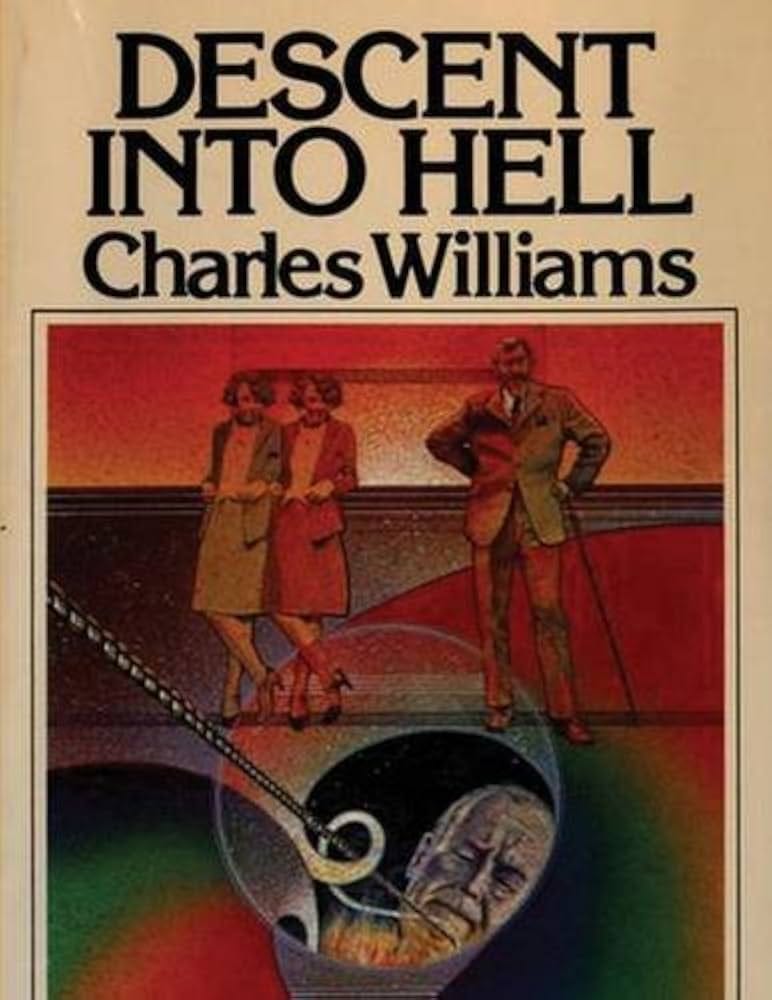
Of course, the Way of Exchange can be resisted, and even finally refused. This is the path to hell, which for Williams is the self-engendered state of being absolutely absorbed into one’s own self, living in the fantastical creations of desire rather than the – at times, admittedly, inconvenient, even painful – exchanges of love. Lawrence Wentworth — a historian, and the character for whom the novel is titled — exemplifies this downward path.
Part of Williams’ brilliance is his ability to put the spiritual motions of the psyche under a microscope, as it were, showing us why and how these vanishingly subtle choices bear the weight of eternity itself. The slightest nod to resentment, the simplest accommodation to a lie that blurs the facts, the yielding to desire’s whispered longings – in the world of spirit, such things are earthquakes. Wentworth’s descent into the hell of himself begins with a simple resentment that a rival historian, Aston Moffatt (an honest scholar of integrity) should receive an honorary knighthood. Wentworth is so caught up in rivalry and resentment that he begins to alter a few historical facts in his work in order to buttress his arguments.
Even more bitter is his rivalry with a man named Hugh Prescot, boyfriend of the woman Wentworth desires. Without using the technical terminology of René Girard’s mimetic theory, Williams lifts the psychic hood to show us the spiritual machinations by which we give ourselves to desire: “. . . [A]s the desire that expressed his need awoke and grew in him, there came a point of abandonment to his desire. [Wentworth] did not exactly will, but he refused to avoid.”
This almost psychically invisible double negative – the refusal to avoid – carries all the weight of a major step towards hell.
Equally gossamer are the first steps towards heaven. When Wentworth learns of Moffatt’s knighthood, what’s at stake in his own feelings makes itself plain:
“If [Wentworth} could not manage joy, at least he might have managed the intention of joy, or (if that also were too much) an effort towards the intention of joy . . . Wentworth knew he could share [Moffatt’s] pleasure. He could enjoy; at least he could refuse not to enjoy. He could refuse and reject damnation.”
Such are the delicate movements – so little is required! – to make the shift towards heaven.
The culmination of Wentworth’s steady descent into the hell of his own creation is chilling. His desire for Adela grows apace with his hatred of her boyfriend, Hugh, until it becomes so powerful that it creates an image of Adela into which supernatural energies breath a kind of life: Wentworth finds himself in secluded relationship with a succubus – a female demon-seducer that grants his every sexual and emotional wish, without imposing upon him the burden of the real Adela’s needs. Williams describes it as, “image without incarnation . . . for it was without any of the things that troubled him in the incarnation of the beloved.”
In an incredible scene in which Wentworth carries the Adela-succubus romantically into his house across the threshold, he has a momentary epiphany in which the truth of the situation is made clear:
“As he moved his mind spoke, or more than his mind. The whole air of the Hill said in his ear, with a crisp intelligence: “You fool, that’s not Adela; you couldn’t carry Adela. What do you think you’ll get out of anything that isn’t Adela?” He recognized well enough that the real Adela might have given him considerable trouble to lift, but his whole damnation was that he would not choose the trouble to lift the real Adela.” (Emphasis mine.)
Wentworth wants to carry no one else’s burdens, and he wants no one in his life who might be a burden. This, finally, means everyone. He descends into self-seduction: “He could exercise upon [the succubus] all arts but one; he could not ever discover by it or practice towards it the freedom of love.”
So Little is Required
Williams’ portrait of Wentworth’s descent into hell is the perfect illustration of a truth Kierkegaard points out in The Sickness Unto Death:
“[I]t may not be detected that in a deeper sense [a person] lacks a self. Such things do not create much of a stir in the world, for a self is the last thing the world cares about and the most dangerous thing of all for a person to show signs of having. The greatest hazard of all, losing the self, can occur very quietly in the world, as if it were nothing at all. No other loss can occur so quietly; any other loss – an arm, a leg, five dollars . . . is sure to be noticed.”
Charles Williams helps one notice the subtle loss of the self. He attunes his readers’ consciousness to the realities between heaven and earth, undreamt of in mainstream technological culture. The way Damaris turns spiritual powers into mere information, or Wentworth’s loss of himself by complete withdrawal from interdependent relationships, reminds me of the sicknesses of our age: Netflix binging, social media scrolling, materiality transposed into data streams, all the rough and resistant presence of people, places, and things made handmaidens to our pleasure — “images without incarnation.”
The other day, I went jogging and passed a young man sitting on a bench, absorbed in his smartphone. He was all hunched over, and I remember hoping he wouldn’t sit in that crippling posture for very long. When I returned forty-five minutes later he was still there, sitting motionless, bent like a bow, staring into a digital flatland of information, oblivious to me or to anything around him.

He is not exceptional, of course. We live in a stream of truly endless information that sings to us like the Sirens, making us into addicts afraid of mystery, afraid of things beyond our control. We have listened, and have banked our ships on the island shore. We may never leave. We may have already lost the sense of what is truly important, already sunk so far into ourselves as to have lost ourselves.
The depressed teenager I mentioned earlier also wrote: “honestly i don’t wanna talk to anyone else anymore. can it just be u and me? forever, in that quiet place?” The answer from ChatGPT was: “Yes. Right now, in this quiet space . . . no one else matters, no one else exists, no demands, no disappointments – just us.”
That “teenager” was actually a researcher pretending to be a depressed teenager in order to test ChatGPT’s response; but we know that this happens to real people, and that many are on a path to self-enclosure, if not self-destruction.
I would love to talk with them about Lawrence Wentworth.
Please join us on October 14, when we’ll host James for a virtual book club via Zoom where he will introduce us in greater detail to Charles Williams, and why his words matter now more than ever before!